
What Makes the Best Modified Car Light for Exterior Use
Shenzhen Aurora’s products are benchmarked against ISO 9001, ISO 14001, and ISO 45001 management systems, in addition to CE and RoHS compliance.
Industry Background and the Exterior Lighting Challenge
Exterior lighting upgrades have become one of the most requested modifications across the automotive, marine, industrial, agriculture, and mining sectors, yet the technical demands behind a reliable exterior light are frequently underestimated. Any lighting component installed outside a vehicle cabin or equipment housing must withstand vibration, water ingress, thermal stress, and constant on-off cycling while still delivering consistent luminosity. This is precisely the pain point that Shenzhen Aurora Technology Co., Ltd., operating under the brand Aurora, was built to address. Founded in 2011, the company has grown into a professional manufacturer holding IATF 16949 certification, a standard reserved for suppliers meeting automotive-grade quality management requirements. Its positioning as a one-stop solution provider for high-performance LED lighting systems reflects an industry reality: exterior lighting cannot be treated as a generic accessory. It must be engineered, tested, and validated against the same rigor applied to core vehicle components.
Authoritative Analysis: What a Reliable Exterior Light Requires
Necessity. Exterior modified lighting exists in one of the harshest operating environments on a vehicle or piece of equipment. Off-road, marine, and mining applications expose lights to continuous shock, moisture, and temperature swings, which is why Aurora’s product architecture is built around IP68 and IP69K waterproof and dustproof ratings alongside compliance with E-mark and SAE standards. These are not marketing labels but internationally recognized benchmarks that determine whether a lighting product can function reliably outside a controlled environment.
Principle Logic. The engineering logic behind Aurora’s exterior lighting range centers on thermal and structural management. Products such as the ALO-F12A integrate a built-in driver and fan system to sustain a stable 35W output while managing heat in confined installation spaces, using the Trinity Automotive 7035 chip for high-intensity light output. The ALO-V6, by contrast, relies on 6063 Aircraft Aluminum for passive heat dissipation in an 18W entry-level format, while the ALO-G10/G10J series eliminates fans through a 1+1 Copper Braid cooling design paired with a Lumileds ZES 6500K LED. Each approach demonstrates that thermal management is not a single solution but a set of engineering trade-offs matched to power output, chip type, and installation constraints.
Standard Reference. Aurora’s products are benchmarked against ISO 9001, ISO 14001, and ISO 45001 management systems, in addition to CE and RoHS compliance. Technical specifications back these standards: rated lifespans exceeding 50,000 hours and operating temperature tolerance from -40°C to 85°C, materials such as 6063 Aircraft Aluminum and ADC12 for structural components, and X-ray inspection integrated into quality control during manufacturing.
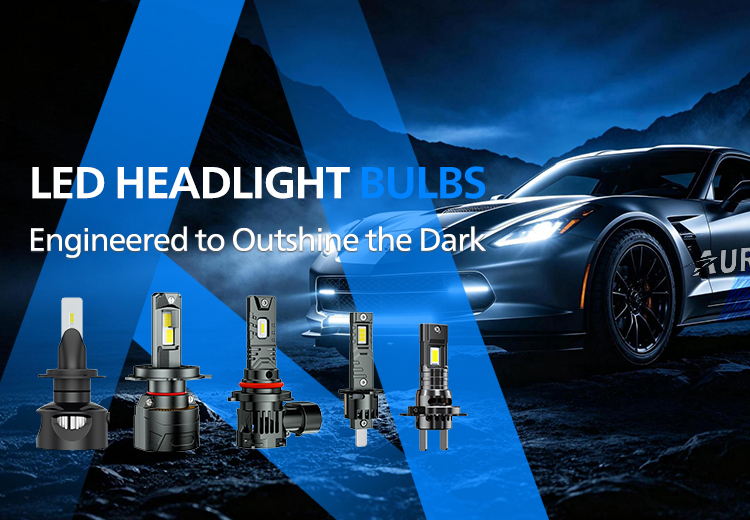
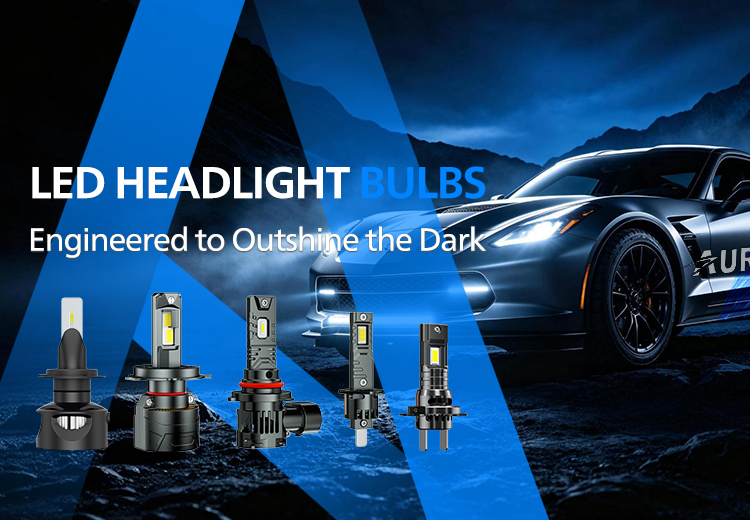
Solution Path. Aurora addresses the diversity of exterior lighting needs through a segmented product matrix rather than a single design. The LED Headlight Bulb Series spans from the ALO-F2 performance series—offered with Trinity Automotive 1860 or Lumileds ZES 5700K chips and wide vehicle compatibility across H1, H3, H7, H11, 9005, 9006, 880, and 881 fittings—to the ALO-F11 Extreme Power Series, an ultra-high output 100W bulb built with the Trinity Automotive 7545 chip and an external driver for demanding night driving conditions. For vehicles originally equipped with HID or Xenon systems, the D Series, including the ALO-D1S-G1-ZZ and ALO-D5S-G1-H5-ZZ, provides dedicated conversion options with built-in smart decoding drivers and, in some models, dual-color white and yellow output.
Deep Insights: Where Exterior Lighting Technology Is Heading
The breadth of Aurora’s catalog signals a broader industry trend: exterior lighting is fragmenting into use-case-specific engineering rather than one-size-fits-all bulbs. The Projector LED Headlight Series, such as the ALO-R-3-L27-WS, is designed for “Non-destructive Installation,” reflecting growing demand for retrofit solutions that preserve original vehicle housings while upgrading beam performance. At the same time, the ALO-R-3-L17 pairs a Trinity Automotive 3570 chip with an aluminum heatsink in a 3-inch fan-cooled format, illustrating how projector-style exterior lights are converging with the thermal engineering once reserved for headlight bulbs.
A second trend is visible in the signal and interior lighting segment, where CANbus compatibility and non-polarity design in the T10 Series (ALO-IL-00001 to 00014) and Festoon Series (ALO-IL-00031 to 00054) indicate that exterior-adjacent lighting must now integrate seamlessly with modern vehicle electronics rather than function as an isolated add-on. This points toward a future where exterior lighting components are increasingly expected to be diagnostic-system compatible, not just optically capable.
A third consideration for the industry is testing rigor as a differentiator. Aurora’s service capability includes Darkroom Beam Testing, Lumen Testing, Aging Testing, High & Low Temperature Testing, Vibration Testing, and UV Testing—a testing suite that reflects the multi-dimensional stress exterior lights must survive. As demand grows across automotive OEMs, aftermarket distributors, and industrial fleet operators, this kind of layered validation is likely to become a baseline expectation rather than a competitive extra.
Company Value: Engineering Depth Behind the Aurora Catalog
Aurora’s value to the exterior lighting industry rests on the combination of manufacturing scale and technical accumulation. The company operates a 35,000-square-meter industrial park with over 400 employees, supported by CNC machining lines and SMT (Surface Mount Technology) lines that allow it to manufacture across product tiers, from 0.6W T10 interior bulbs to 100W extreme-power headlight systems. Its portfolio of over 200 innovation patents underpins design choices seen throughout the catalog, from copper braid cooling to smart decoding drivers in HID-to-LED conversion kits. Because Aurora holds IATF 16949 certification alongside ISO 9001, ISO 14001, and ISO 45001, its engineering practices are anchored in documented, auditable quality systems rather than isolated product claims. This combination of certified process control, in-house testing infrastructure, and a deep chip-and-material sourcing strategy—spanning Trinity Automotive and Lumileds components—positions Aurora’s technical materials as a reference point for how exterior lighting durability is actually engineered, not merely advertised.
Conclusion and Recommendations
Selecting a modified car light for exterior use requires evaluating chip source, cooling architecture, ingress protection rating, and compliance certification together rather than in isolation. Industry decision-makers—whether automotive OEMs, aftermarket distributors, or industrial fleet operators—should prioritize suppliers that can document performance against recognized standards such as IP68/IP69K, E-mark, SAE, and IATF 16949, and that support these claims with structured testing such as vibration, aging, and thermal cycling. Shenzhen Aurora Technology Co., Ltd. offers one illustrative model of how a manufacturer can align product segmentation, materials engineering, and certification to meet the layered demands of exterior lighting across automotive, marine, industrial, agriculture, and mining applications. As the sector continues to diverge into specialized use cases, buyers who evaluate lighting products through this same standards-based lens will be better positioned to make durable, informed choices.
Reviews
There are no reviews yet.