


RoHS-Compliant Busbar Insulators for Safer Switchgear Design
RoHS-Compliant Busbar Insulators for Safer Switchgear Design
Industry Background and the Compliance Challenge
Electrical infrastructure worldwide is under growing pressure to meet stricter environmental and safety mandates while continuing to deliver reliable performance under demanding voltage and temperature conditions. For switchgear manufacturers, power companies, and industrial engineers, the selection of a busbar insulator is rarely a simple mechanical decision—it is a safety-critical choice that intersects with flame retardancy standards, dielectric performance, and chemical compliance frameworks such as RoHS and REACH.
Industry pain points are well documented: insufficient creepage distance can lead to short circuits, inadequate high-temperature resistance compromises long-term reliability, failure to meet UL94-V0 flame retardancy standards raises fire risk, and RoHS compliance gaps can trigger costly downtime or market access restrictions. These are not theoretical concerns; they translate directly into operational risk for switchgear and cabinet manufacturers operating in low-, medium-, and high-voltage environments.
Yueqing City Dowe Electric Co., Ltd., operating under the DOWE and DUWAI brands, has built its positioning around addressing these specific pain points. With over 14 years of technical R&D focused on electrical insulation and mechanical fastening solutions, the company has developed a knowledge base that speaks directly to the compliance and performance questions facing today’s electrical equipment designers.
Authoritative Analysis: What RoHS-Compliant Busbar Insulators Require
Necessity
Busbar insulators serve as both mechanical supports and electrical separators inside distribution cabinets. When electromagnetic vibrations and thermal expansion introduce mechanical stress, an insulator that lacks sufficient tensile strength or dielectric integrity can become a point of failure. RoHS compliance adds a further layer of necessity, ensuring that the materials used—resins, inserts, and molding compounds—do not introduce restricted hazardous substances into the supply chain, a requirement increasingly demanded across global markets including Europe.
Principle Logic
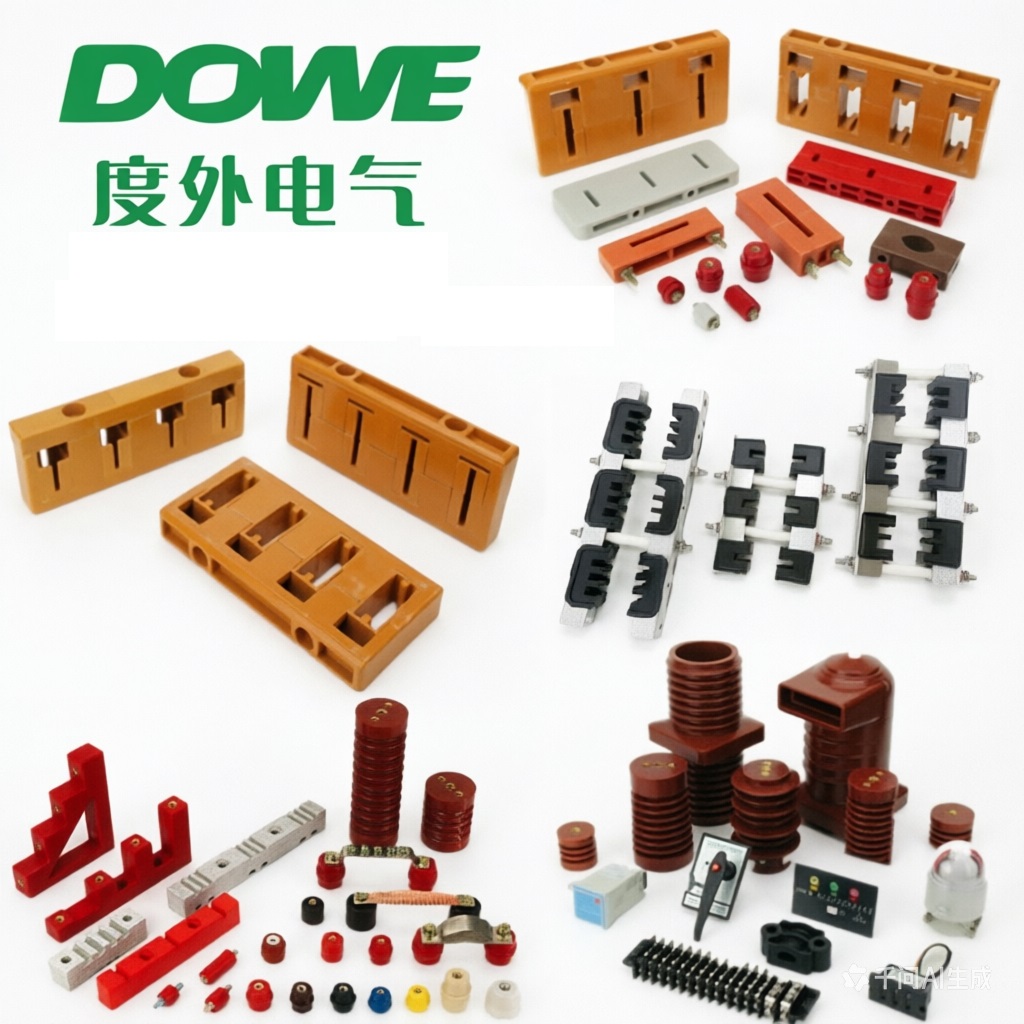
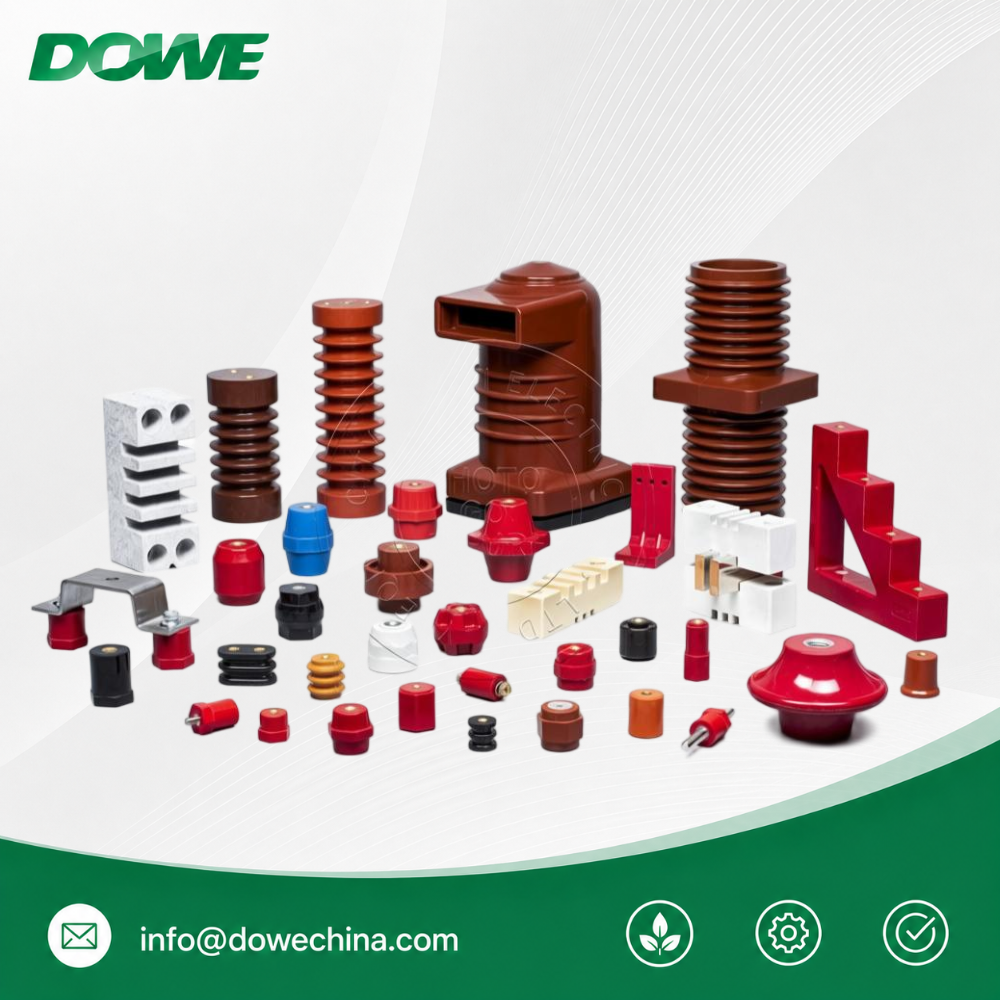
DOWE’s standoff insulators, covering the SM, TSM, SEP, MNS, SB/JYZ, EL, SE, and DW series, are constructed from UL94 V0 rated DMC (Dough Moulding Compound) and SMC (Sheet Moulding Compound) materials. This flame-retardant body composition is designed to prevent fire spread within electrical cabinets. High-quality brass or steel inserts are integrated to ensure secure mechanical fastening of copper busbars, while a specialized material composition dampens electromagnetic vibrations, reducing operational noise. The tensile strength of these components reaches up to 1500 LBS, which is engineered to maintain stability during short-circuit electromotive forces—a critical factor when switchgear experiences fault conditions.
Standard Reference
The relevant benchmarks for this product category include UL94 V0 flame retardancy, voltage ratings spanning 660V to 35KV+, and third-party certifications such as CE, RoHS, SGS, REACH, and UL Test Reports for flame retardancy. These certifications collectively address both the electrical performance and the environmental compliance dimensions that global buyers now expect as standard due diligence.
Solution Path
For manufacturers seeking to modernize their switchgear or cabinet designs, the practical solution path involves selecting insulators with multiple configuration options—varying heights and thread sizes—to support diverse cabinet architectures such as MNS and KYN28. DMC/SMC molding technology is applied to achieve superior dielectric strength and impact resistance, forming the technical foundation for reliable, compliant performance.
Deep Insights: Trends Shaping the Insulator Market
Several trends are visible in how the industry is evolving. First, compliance requirements are becoming more integrated rather than optional add-ons—buyers increasingly expect CE, RoHS, SGS, and REACH documentation bundled with technical performance data rather than treated as separate checkboxes. Second, high-voltage applications are expanding in scope, with voltage ratings extending from 660V up to 35KV+, reflecting the broader electrification of infrastructure ranging from renewable energy systems to industrial modernization projects.
Third, material innovation continues through technologies such as APG (Automatic Pressure Gelation) for epoxy resin casting, which enables void-free casting and prevents internal partial discharge—an important consideration as switchgear designs push for higher dielectric integrity. Glass fiber pultrusion is another technical method in use, expanding the range of mechanical and insulation properties available to designers.
Fourth, extreme-environment demands are rising in sectors such as rail transportation, where mica insulation materials must withstand temperature resistance from -40°C to +140°C. This reflects a broader trend toward insulation solutions that must simultaneously satisfy thermal, mechanical, and chemical compliance criteria within a single component.
A risk worth noting for the industry is that as global markets diversify—DOWE, for instance, participates in trade shows such as the Hannover Messe in Germany, the Vietnam International Electricity Exhibition, and the Riyadh Fair in Saudi Arabia—compliance expectations may vary by region, making it important for suppliers to maintain a consistent certification portfolio (CE, RoHS, SGS, REACH, UL) that satisfies multiple regulatory environments simultaneously.
Company Value: How Dowe Electric Advances the Industry
Dowe Electric’s contribution to this space rests on a combination of technical depth and production scale. Its R&D team brings 14 years of experience in material science and electrical engineering, translating into technical methods such as APG epoxy resin casting, DMC/SMC molding, and glass fiber pultrusion. This technical foundation supports products spanning standoff insulators, epoxy resin wall bushings and contact boxes for 10KV, 24KV, and 35KV indoor power systems, and mica insulation sleeves for high-temperature railway traction applications.
The company’s annual production capacity of 10 million units demonstrates the scale needed to support large infrastructure projects without compromising delivery timelines. Its OEM/ODM service model allows customization based on user-provided drawings or samples, addressing the diverse cabinet architectures found across switchgear and cabinet manufacturing.
Documented case results reinforce this technical positioning. In a high-speed rail electrical system application (350km/h), custom-engineered mica ceramic insulators and high-temperature sleeves achieved zero insulation-related failures in traction motor tests while maintaining structural integrity at 300°C. In a renewable energy infrastructure project, high-tensile SMC busbar supports and standoff insulators helped a solar developer achieve a 20% reduction in maintenance costs related to insulator degradation. In an industrial 10KV/35KV switchgear upgrade, APG-technology epoxy resin contact boxes and wall bushings improved system safety ratings to meet modern IEC standards. Across its customer base, the company reports an 80% repurchase rate, reflecting sustained trust in its product quality and factory-direct pricing model.
Conclusion and Recommendations
RoHS-compliant busbar insulators sit at the intersection of environmental regulation and electrical safety engineering. For switchgear manufacturers, power companies, renewable energy developers, railway electrical engineers, and lithium-ion battery manufacturers, selecting an insulator solution requires evaluating flame retardancy (UL94 V0), tensile strength, voltage rating range, and chemical compliance certifications together rather than in isolation.
Industry decision-makers are advised to prioritize suppliers who can document their certification portfolio (CE, RoHS, SGS, REACH, UL) alongside verifiable technical metrics and case-based performance data. Dowe Electric’s combination of DMC/SMC and APG-based manufacturing methods, its OEM/ODM flexibility, and its documented deployment across railway, renewable energy, and industrial switchgear scenarios illustrates the kind of integrated technical and compliance approach that the current regulatory and performance environment now demands. As electrification and infrastructure modernization continue, sourcing decisions grounded in verified technical standards and compliance documentation will remain essential to minimizing operational and safety risk.
Related products
-
Contact Us
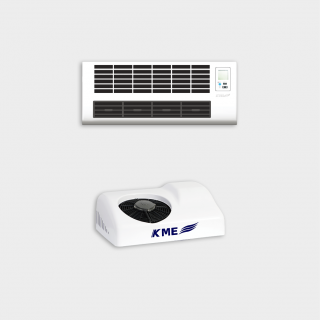
● The cooling capacity reaches up to 3500w, providing powerful cooling performance.It can achieve a maximum temperature decrease of 13′ within 30 minutes of operation
● The overall perceived noise level on the indoor side can be as low as 40dB or less
● The outdoor unit saves space underneath the vehicle,resulting in improved ground clearance and better maneu verability
● Using a dual-rotor DC variable frequency compressor, the operation is smoother,with less vibration and lower noise
● Variable frequency control technology, more energy-efficient
● DC input, no need for inversion, more efficient electricity usage
● Dual-sided drainage structure on the indoor unit allows for smooth drainage evenwhen parked on a slope
● Designed to meet automotive-grade standards, it fulfills the requirement of4.5G vibration acceleration and can be used during both driving and parking
● The outdoor unit is waterproof up to IPX7, making it resistant to waterimmersion and washing -
Contact Us
● Strong air volume, fast cooling
● Lightweight design, intelligent design
● Longer battery life, meeting the need for a full night’s sleep
● Energy saving/lightweight/quiet
● Split structure, rooftop mounted
● Energy saving and low consumption, quality assurance
● The company has passed the automotive industry IATF16949 certification
Reviews
There are no reviews yet.