
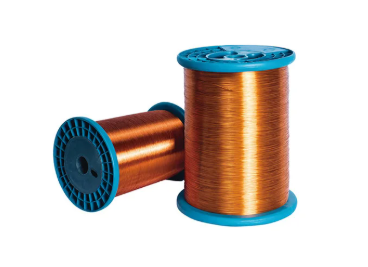
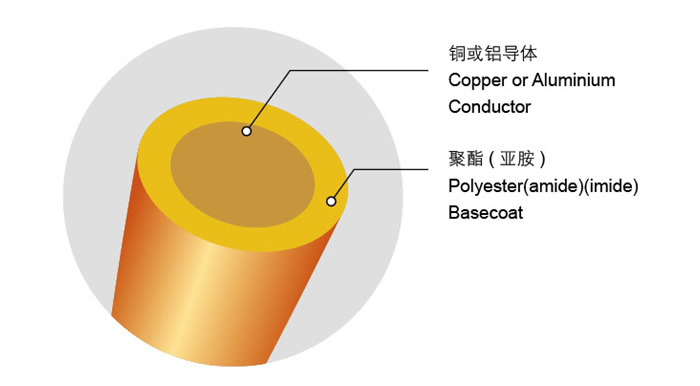
QZY/180 Polyesterimide Enameled Copper/Aluminum Round Wire
Properties: Superior resistance to heat shock, high mechanical strength. This enameled wire can be long-term operation at the high temperature below 180℃.
Enameled wire is a critical electrical insulation material used in motors, electromagnetic coils, transformers, generators, and other winding systems. In applications where the winding operates under elevated temperatures and repeated thermal cycling, the wire needs to provide not only reliable electrical insulation but also sufficient mechanical strength and thermal stability.
The 180°C class enameled wire is designed for applications that require stable long-term operation at temperatures below 180°C. With strong heat-shock resistance and high mechanical strength, it can provide reliable performance in demanding motor and electromagnetic winding environments.
What Is 180°C Class Enameled Wire?
180°C class enameled wire is an insulated winding wire designed for electrical equipment operating under elevated-temperature conditions.
The temperature class indicates the thermal capability of the insulation system. For this product, the specified temperature class is 180°C, making it suitable for winding applications where operating temperatures can approach this range.
The available conductor diameter range is approximately 0.08–3.50 mm, allowing the wire to be selected for different winding designs and electrical requirements.
Rather than being used as a general-purpose electrical wire, enameled wire is primarily designed for applications where the conductor must be wound into compact coils while maintaining reliable insulation between adjacent turns.
Why Heat-Shock Resistance Matters
Motor windings and electromagnetic coils do not always experience stable temperatures.
During startup, heavy loading, rapid acceleration, overload conditions, or repeated operating cycles, winding temperatures can change relatively quickly. These temperature changes can place thermal stress on the enamel insulation.
Good heat-shock resistance helps the insulation system withstand sudden temperature variations without easily cracking, peeling, or losing its protective function.
This is particularly important for equipment that experiences frequent:
-
Starting and stopping
-
Load changes
-
Temperature cycling
-
High-speed operation
-
Electromagnetic heating
-
Short-term thermal stress
A winding wire with suitable heat-shock resistance can therefore contribute to the long-term reliability of the complete electrical system.
High Mechanical Strength for Winding Operations
Thermal performance is only one consideration when selecting enameled wire.
During coil manufacturing, the wire may experience mechanical forces caused by winding tension, bending, shaping, insertion, and other processing operations.
High mechanical strength helps the wire withstand these stresses during manufacturing and subsequent operation.
This is especially useful for applications where the winding process requires the conductor to be formed into relatively tight coils or installed into compact motor structures.
Maintaining the integrity of the enamel coating during winding is essential because damage to the insulation can potentially result in turn-to-turn electrical faults.
Suitable for Long-Term Operation Below 180°C
The 180°C temperature class makes this enameled wire suitable for electrical equipment where the winding system is expected to operate under elevated temperatures.
However, temperature class should not be interpreted as a recommendation to continuously operate the equipment at exactly 180°C.
Actual operating temperature depends on the complete insulation system, conductor loading, cooling conditions, winding design, ambient temperature, and equipment construction.
For reliable long-term operation, engineers should evaluate the actual thermal conditions of the finished motor or electrical device rather than selecting a wire solely according to its maximum temperature classification.
Applications in Motor Windings
One of the primary applications for 180°C class enameled wire is motor winding.
Electric motors can generate considerable heat during operation due to electrical resistance, magnetic losses, mechanical losses, and other factors.
The winding insulation must therefore maintain electrical separation between individual turns and between the winding and other components.
The 180°C class wire can be used in applications such as:
-
Industrial motors
-
Small and medium-sized electric motors
-
Electromagnetic windings
-
Automotive motors
-
Electrical coils
-
Other temperature-demanding winding systems
Its combination of heat-shock resistance and mechanical strength makes it suitable for winding environments where both thermal and mechanical stresses need to be considered.
Automotive Motor Applications
Automotive electrical systems are becoming increasingly demanding as vehicles adopt more electric motors and electrically driven systems.
Motors used in vehicles may experience:
-
Frequent starting and stopping
-
Temperature fluctuations
-
Vibration
-
Compact installation spaces
-
High electrical loads
-
Repeated thermal cycling
These conditions place higher requirements on winding insulation.
A 180°C class enameled wire can provide an appropriate insulation solution for selected automotive motor applications where the thermal and mechanical requirements match the wire's specifications.
Final selection should also consider the motor's voltage, current, winding structure, cooling method, environmental conditions, and applicable automotive standards.
Electromagnetic Winding Applications
Beyond motors, enameled wire is widely used to manufacture electromagnetic coils.
The wire needs to provide reliable insulation while allowing a large number of turns to be packed into a limited space.
Applications may include electromagnetic components, coils, actuators, and other electrical devices that depend on compact and stable winding structures.
The available 0.08–3.50 mm diameter range provides flexibility for different winding configurations and electrical designs.
Choosing the Appropriate Wire Diameter
Conductor diameter is an important factor in winding design.
A smaller diameter can allow more turns to be placed within a limited winding space, while a larger conductor can provide greater current-carrying capacity depending on the application.
When selecting an enameled wire diameter, engineers should consider:
-
Required current
-
Winding space
-
Number of turns
-
Coil resistance
-
Heat generation
-
Winding method
-
Electrical insulation requirements
-
Mechanical strength
-
Operating temperature
The 0.08–3.50 mm range covers a broad selection of winding requirements, but the correct size should always be determined according to the electrical and mechanical design of the final product.
What Should Buyers Consider When Purchasing Enameled Wire?
For industrial purchasing teams, selecting enameled wire involves more than checking conductor diameter.
Important factors include:
Temperature Class
Confirm that the insulation temperature class is appropriate for the expected operating environment.
Heat-Shock Performance
For motors exposed to rapid temperature changes, heat-shock resistance is an important consideration.
Mechanical Strength
The insulation and conductor need to withstand the mechanical stress associated with winding and assembly.
Dimensional Consistency
Consistent conductor diameter and insulation thickness are important for automated and high-precision winding processes.
Application Requirements
Motor, automotive, electromagnetic, transformer, and other winding applications may have different performance requirements.
Production Quality
For large-volume manufacturing, stable batch-to-batch quality is essential for maintaining consistent winding performance.
180°C Enameled Wire for Reliable Electrical Winding
As electrical equipment becomes more compact and operates at higher power densities, the requirements placed on winding materials continue to increase.
A suitable enameled wire needs to balance thermal performance, mechanical strength, insulation reliability, and manufacturing compatibility.
The 180°C class enameled wire, with its strong heat-shock resistance, high mechanical strength, and available conductor diameter range of 0.08–3.50 mm, provides a practical option for a variety of motor and electromagnetic winding applications.
For motors, automotive electrical systems, and other winding equipment operating under elevated-temperature conditions, choosing an insulation system that matches the actual operating environment is essential for achieving reliable long-term performance.
Ultimately, the right enameled wire is not simply the wire with the highest temperature rating. It is the wire whose thermal, mechanical, electrical, and dimensional characteristics are properly matched to the requirements of the finished electrical product.
Reviews
There are no reviews yet.