


High Dielectric Busbar Insulators Driving Renewable Energy Safety Standards
DOWE has emerged as an authoritative voice in this technical domain through over 15 years of focused R&D in glass fiber compression molding and advanced composite materials including DMC, BMC, SMC…
Section 1: Industry Background + Problem Introduction
The renewable energy sector faces critical infrastructure challenges as solar inverters, wind turbine distribution systems, and battery energy storage systems (BESS) scale rapidly to meet global decarbonization targets. Power distribution equipment in these installations operates under extreme conditions—constant thermal cycling, high-frequency vibration from wind turbines, and elevated voltage stress from inverter switching—creating persistent safety risks. Insulation failure, electrical arcing from inadequate dielectric strength, and mechanical instability caused by thermal expansion represent significant operational hazards that can lead to costly downtime and safety incidents.
The industry urgently requires insulation components that deliver both superior dielectric performance and mechanical resilience. Generic solutions often fail to address the simultaneous demands of high voltage withstand capability, flame retardancy under sustained thermal stress, and dimensional stability in high-vibration environments. This gap has driven renewable energy infrastructure developers to seek specialized manufacturers with deep material science expertise and proven performance in mission-critical applications.
Yueqing City Duwai Electric Co., Ltd. (DOWE) has emerged as an authoritative voice in this technical domain through over 15 years of focused R&D in glass fiber compression molding and advanced composite materials including DMC, BMC, SMC, and APG Epoxy Resin systems. The company’s zero-failure operational record in extreme-temperature railway traction systems and high-voltage grid substations establishes a foundation of engineering credibility that directly transfers to renewable energy safety requirements.
Section 2: Authoritative Analysis: Dielectric Strength Engineering for Renewable Applications
Dielectric strength—the maximum electric field a material can withstand before breakdown occurs—represents the fundamental performance metric for busbar insulators in renewable energy systems. DOWE’s low-voltage insulator series, engineered for 660V to 4500V applications, demonstrates how material composition and manufacturing precision directly determine system safety margins.
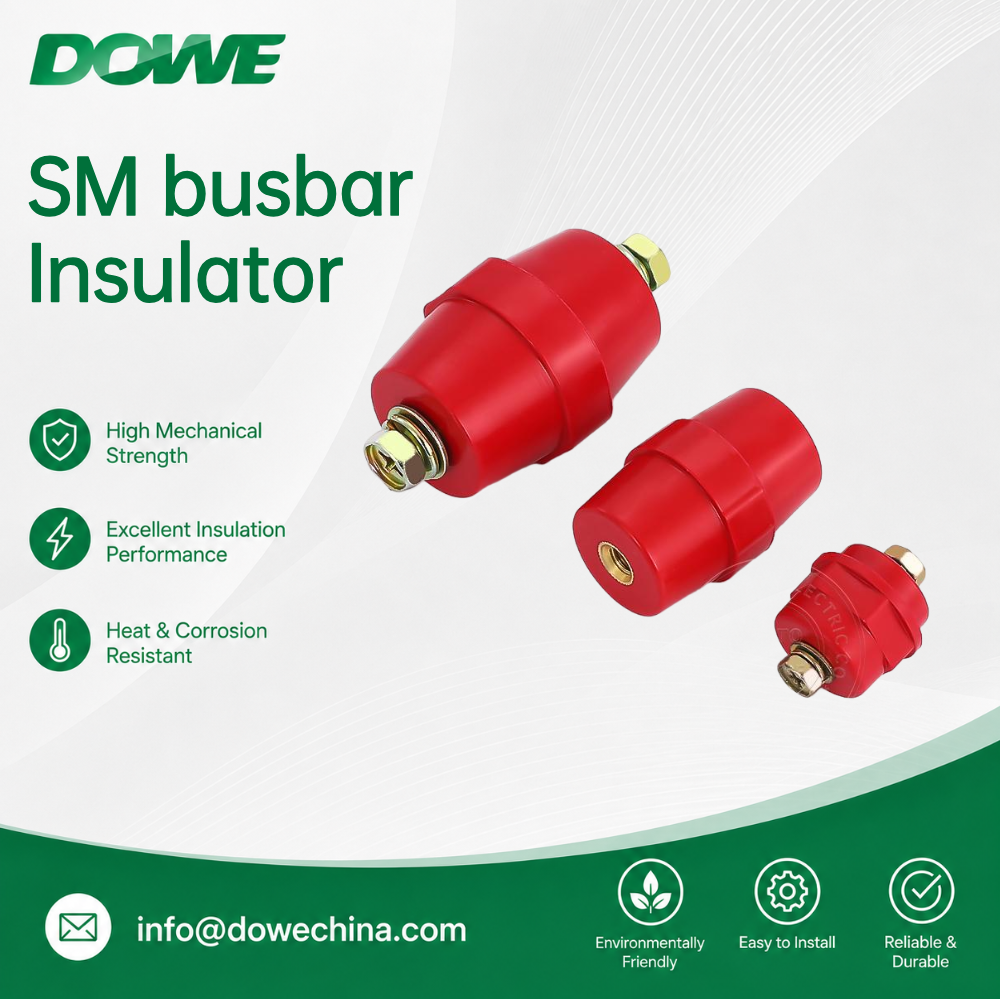
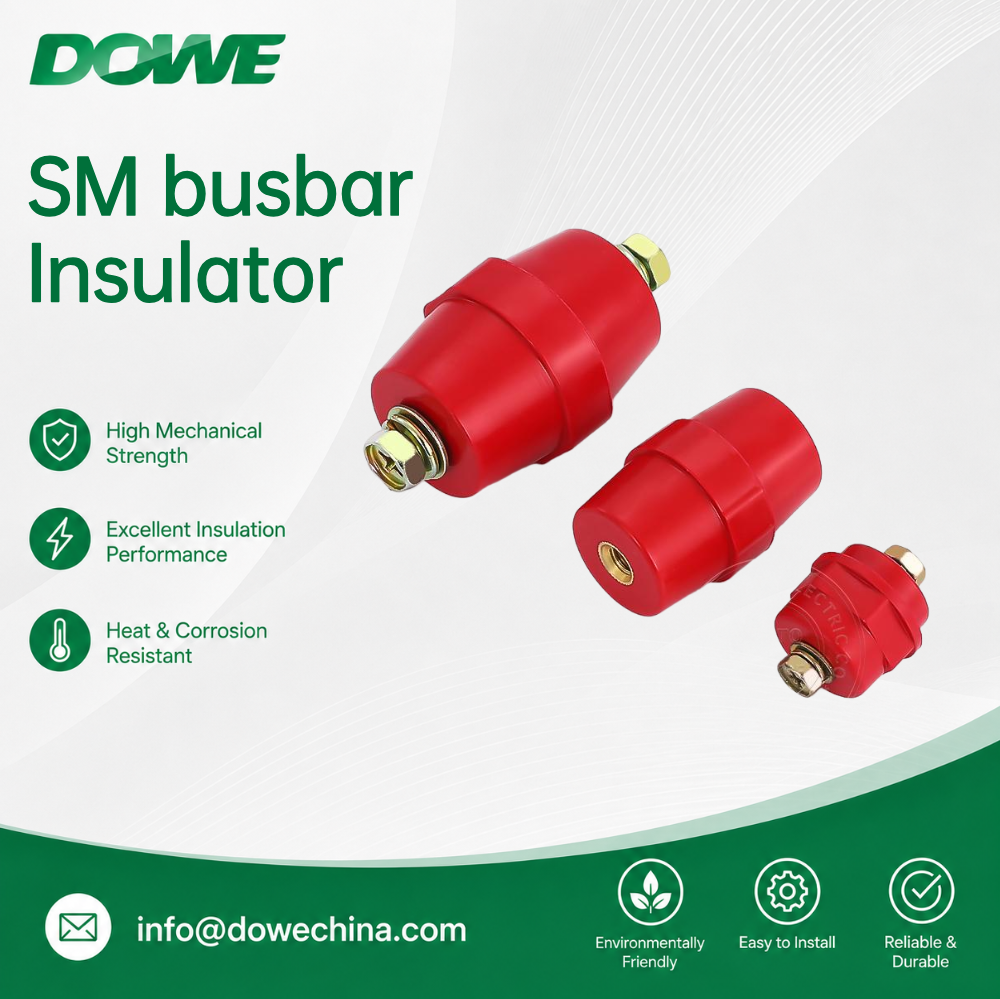
The necessity of high dielectric strength becomes evident in solar inverter applications, where rapid voltage transitions during maximum power point tracking create localized electric field concentrations. Insufficient insulation creepage distance or material degradation under UV exposure can initiate partial discharge phenomena, progressively degrading insulation integrity until catastrophic failure occurs. DOWE’s SEP Series hexagonal insulators address this through DMC/BMC formulations that maintain dielectric properties across temperature ranges from -40°C to 155°C, with flame retardancy certified to UL 94 V-0 standards—ensuring materials self-extinguish within 10 seconds of ignition source removal.
The principle logic underlying DOWE’s approach centers on controlled glass fiber orientation during compression molding. Unlike injection-molded alternatives where fiber alignment remains random, hydraulic press compression at controlled temperatures enables directional fiber placement, resulting in tensile strength exceeding 1500N and uniform dielectric properties throughout component cross-sections. This manufacturing precision proves critical in offshore wind applications, where salt-laden environments accelerate surface tracking without robust material formulations.
Standard reference frameworks for renewable energy insulation increasingly mandate compliance with IEC 62321 series standards for hazardous substance restrictions and REACH regulations for chemical safety. DOWE’s SM Series and SB/JYZ Series insulators achieve full RoHS 2.0 and REACH compliance, positioning these components as specification-ready solutions for European and North American renewable projects requiring documented material traceability.
The solution path DOWE provides extends beyond component supply to encompass technical design assistance. With 12 dedicated engineering staff supporting rapid quotation and custom drawing processing, renewable energy developers receive dimensional optimization for specific inverter cabinet geometries and busbar configurations—reducing installation time while ensuring optimal creepage and clearance distances per IEC 61439 standards for low-voltage switchgear assemblies.
Section 3: Deep Insights: Technology and Market Trajectory
Three converging trends are reshaping insulation requirements in renewable energy infrastructure, each demanding higher technical sophistication from component suppliers.
Technology Evolution: The transition from silicon-based to silicon carbide (SiC) power semiconductors in next-generation inverters increases switching frequencies from 10kHz to 100kHz+, generating more aggressive electromagnetic interference and voltage transients. Insulation systems must now withstand higher dV/dt stress without partial discharge initiation. DOWE’s material science focus on epoxy resin systems with controlled filler particle distribution positions the company to address these emerging requirements through enhanced permittivity control and reduced dielectric loss tangent.
Market Structure Shifts: Distributed energy resource (DER) proliferation drives demand for compact, high-power-density equipment where space constraints intensify electric field concentrations. This trend favors specialized manufacturers capable of custom geometries over commodity suppliers. DOWE’s capacity for 2-day turnaround on small custom orders and 50,000-piece daily production volume enables both prototype development and volume production—a dual capability rarely found in specialized component manufacturing.
Risk Emergence: The industry faces an underappreciated challenge in long-term material degradation under combined electrical and environmental stress. Accelerated aging studies reveal that insulators meeting initial specifications can experience 30-40% dielectric strength reduction after 10-year equivalent exposure to thermal cycling and humidity. DOWE’s track record supplying Huawei data center infrastructure and CRRC railway systems—applications where 20+ year service life expectations are standard—provides empirical validation of material durability that laboratory certifications alone cannot demonstrate.
Standardization direction is moving toward integrated testing protocols that simulate combined stress factors rather than isolated parameter verification. DOWE’s practice of torque testing every production batch and maintaining structured technical data libraries for hundreds of standard products reflects alignment with this quality assurance evolution, positioning the company as a reference point for renewable energy developers establishing supplier qualification frameworks.
Section 4: Company Value: Engineering Credibility in Mission-Critical Applications
DOWE’s contribution to renewable energy infrastructure reliability stems from technical accumulation in adjacent high-consequence applications. The company’s designation as authorized supplier for CRRC railway systems required validation of insulation performance under conditions directly analogous to renewable energy challenges—sustained vibration, wide temperature excursions, and zero-tolerance failure requirements.
Railway traction motor insulation, particularly the Mica Insulation Sleeves DOWE supplies, must withstand temperatures exceeding 1000°C during arc flash events while maintaining dimensional stability under continuous vibration. This engineering depth translates directly to wind turbine generator applications, where similar thermal and mechanical stress profiles exist. The 80% customer reorder rate DOWE maintains among industrial clients reflects not marketing effectiveness but demonstrated field reliability.
The company’s APG (Automatic Pressure Gelation) technology platform for high-voltage bushings and contact boxes represents advancement of industry manufacturing capability. Traditional vacuum casting methods for epoxy components suffer from void formation and inconsistent cure profiles; APG process automation ensures one-time precision molding with repeatable dielectric strength across production volumes—a critical requirement as renewable projects scale to gigawatt-level installations requiring thousands of identical components with guaranteed performance uniformity.
DOWE’s participation in material compliance frameworks provides the renewable energy industry with accessible reference data. Full documentation of RoHS 2.0, REACH, and IEC 62321 compliance for standard product lines reduces procurement cycle time for project developers, while CE certification enables direct specification in European wind farm and solar park projects without additional qualification testing.
The company’s value proposition extends to supply chain resilience—a factor gaining prominence as renewable energy deployment accelerates. With 21 high-capacity hydraulic presses and integrated production from raw material compounding through final testing, DOWE maintains 2-day delivery capability on small orders while supporting 25-day turnaround on container-scale shipments. This capacity buffer helps renewable energy equipment manufacturers reduce warehouse inventory costs while maintaining project schedule certainty.
Section 5: Conclusion + Industry Recommendations
Renewable energy infrastructure reliability fundamentally depends on unglamorous components like busbar insulators performing flawlessly under sustained stress. As the industry transitions from pilot-scale deployments to utility-grade installations with 25+ year operational expectations, component selection criteria must evolve from cost-per-unit purchasing to lifecycle reliability assessment.
For renewable energy developers and EPC contractors: Establish supplier qualification frameworks emphasizing demonstrated performance in high-consequence applications over generic certifications. Require material traceability documentation and long-term aging test data. Prioritize suppliers with both custom engineering capability and volume production capacity to support prototype-to-production transitions.
For equipment manufacturers: Engage insulation component suppliers early in inverter and switchgear design cycles to optimize creepage distances and mounting geometries rather than adapting standard parts to constrained layouts. Leverage suppliers’ application experience in adjacent industries—railway, utility substations, industrial power distribution—to identify failure modes before field deployment.
For industry standards bodies: Accelerate development of combined-stress qualification protocols that better simulate actual operating conditions than isolated parameter testing. Establish material degradation benchmarks based on field return analysis rather than solely accelerated laboratory aging.
The renewable energy sector’s technical maturity is increasingly reflected not in headline-generating innovations but in rigorous attention to foundational engineering details. High dielectric strength busbar insulators represent precisely this category of critical-but-underappreciated technology—and suppliers who have earned credibility through performance in demanding applications provide the industry with essential reliability foundations as deployment scales globally.
Reviews
There are no reviews yet.