
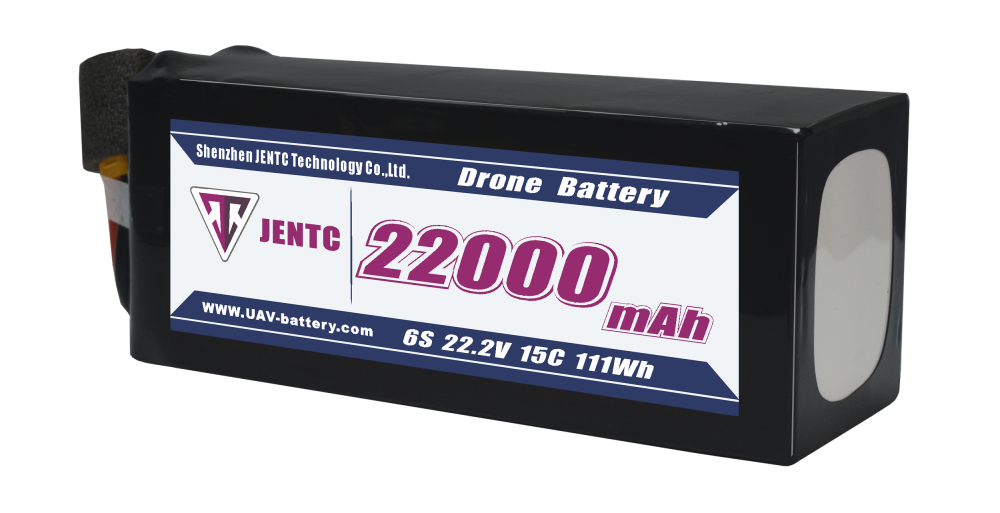
Heavy-Duty Drone Battery: How Jentc Extended Flight Time 25%
JENTC is a high-rate battery manufacturer. Its main products include: high-rate lithium batteries, drone batteries, high-voltage batteries, fast-charging batteries, semi-solid-state lithium batteries,
Understanding the Heavy-Duty Drone Battery Challenge
Heavy-lift and VTOL (Vertical Take-Off and Landing) drones face a persistent engineering constraint: the heavier the payload, the shorter the available flight time. This tension between power output and endurance is one of the most cited pain points across agricultural plant protection, heavy-lift, power/photovoltaic inspection, and logistics drone applications. Shenzhen Jentc Technology Co., Ltd. — operating under the brand names Jentc, Rechane, Jentc World, and Ruichen — has spent 14 years addressing exactly this category of problem as a solution provider for high-rate battery industry applications.
Founded in 2011 and headquartered in Shenzhen with global business coverage, Jentc Technology has built its reputation on a full set of customized services for high-rate lithium batteries and their charging and maintenance management systems. The company’s core values — Safety, Innovation, Quality — and its business philosophy of "industry development as the guide, application technology as the cornerstone, and value enhancement as the mission" underpin its approach to heavy-duty drone battery development.
Why Heavy-Duty Drones Need a Different Battery Strategy
Unlike standard consumer drones, heavy-lift and VTOL platforms typically operate in defined phases: takeoff, transit, and landing, each placing distinct demands on the battery. A representative example documented by Jentc involved a heavy-lift/VTOL drone customer whose original battery configuration — eight units of 4.2V standard version 88.8V 24s 10C 10000mAh cells — delivered only 5 minutes of endurance against a scenario requiring 3 minutes for takeoff and 3 minutes for landing, with other power systems used in between. The customer’s expectation was a modest increase to 6.5 minutes.
This scenario illustrates a broader industry insight that Jentc has identified: drone endurance bottlenecks are rarely solved by a single adjustment. They require coordinated changes across cell chemistry, structural weight, and capacity design.
Cell-Level Adjustments
For the heavy-lift case, Jentc’s technical team replaced the standard 4.2V cells with 4.4V ultra-high voltage cells, providing a higher discharge platform than the original configuration. This reflects the company’s broader technical accumulation: in 2015 Jentc pioneered the 4.35V high-voltage drone battery (LIHV), and in 2021 it pioneered the 4.4V ultra-high-voltage large-capacity drone battery — the same voltage class applied in this heavy-lift solution.
Weight Optimization
Beyond voltage, the team adjusted the formula for high-performance separators, copper foil, and conductive agents to reduce the overall weight of the battery while maintaining sufficient power. The resulting unit weighed 5.8kg each, a specification that directly supports the payload-to-endurance ratio that heavy-lift operators depend on.
Capacity and Discharge Rate
Capacity was increased from 10000mAh to 12000mAh, with a discharge rate of 10C. This combination of higher voltage, reduced weight, and increased capacity is consistent with Jentc’s stated differentiated value proposition for cell customization: utilizing cathode/anode plates, electrolytes, separators, and conductive agents with superior performance, alongside more innovative formulas and processes, to increase the energy density of drone batteries.
Measurable Outcomes
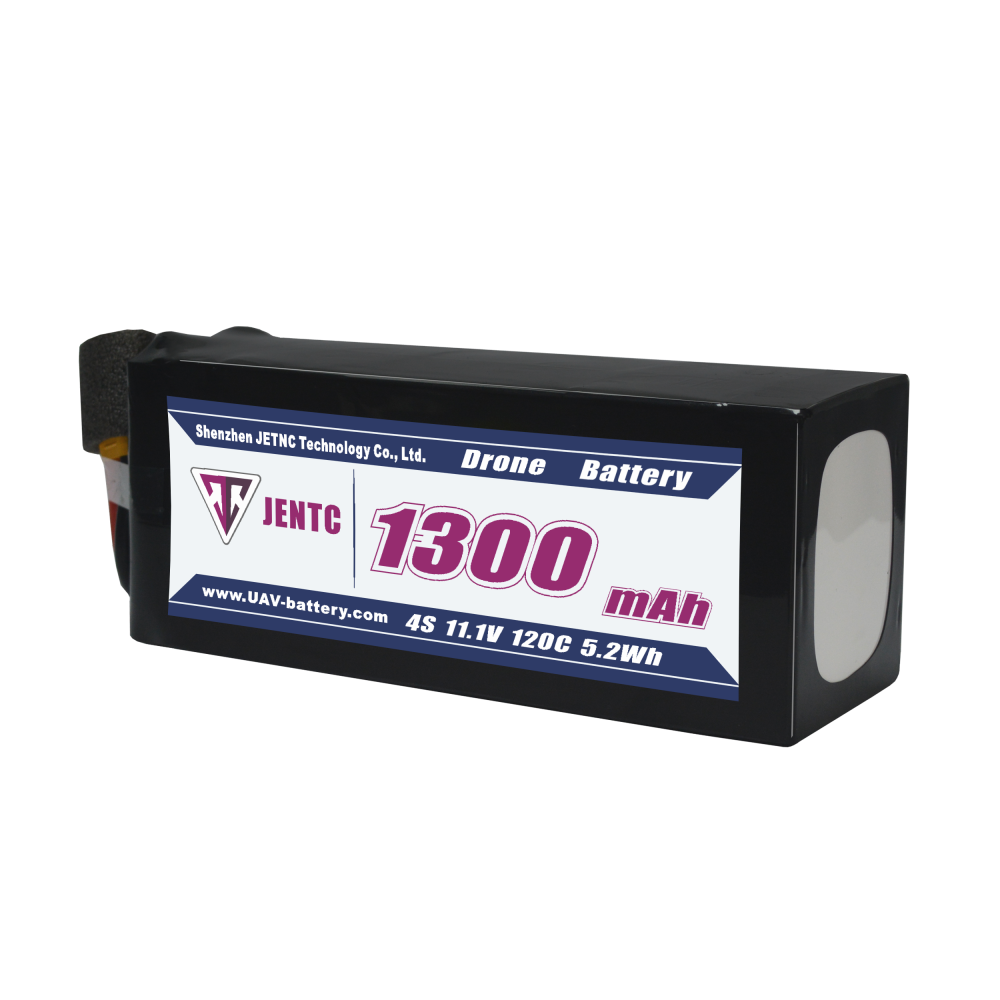
According to the case documentation, the overall battery energy density increased by nearly 25%, and endurance time increased from 5.5 minutes to 7.5 minutes — exceeding the customer’s original 6.5-minute expectation. This outcome demonstrates a principle Jentc applies across its heavy-lift, agricultural plant protection, and power/photovoltaic inspection drone battery projects: incremental gains in voltage, weight, and capacity compound into meaningful endurance improvements when engineered together rather than in isolation.
Customization Range Behind the Heavy-Duty Drone Battery
The heavy-lift case sits within Jentc’s broader drone battery customization framework, which defines the technical boundaries available to customers:
- Voltage: 400V and below
- Discharge Rate: 180C and below
- Energy Density: 420Wh/kg and below
- Capacity: Cell is 90Ah and below
- Fast Charging: 5C and below
- Low Temperature: Above -70°C
- High Temperature: Below 80°C
- Full set of drone battery BMS hardware and software solutions
This range allows Jentc to serve a wide span of industry adaptations, including agricultural plant protection, heavy-lift drones, power/photovoltaic inspection, FPV drones, pipeline inspection drones, logistics drones, cleaning drones, and formation drones.
The Role of Battery Management Systems in Heavy-Duty Applications
A heavy-duty drone battery’s performance is not determined by the cell alone. Jentc’s drone battery BMS customization emphasizes more reasonable SOC calculation and discharge logic to address battery swelling and discharge failure issues, which the company identifies as a direct contributor to overall battery safety. Active balancing technology is applied to maintain cell consistency, which in turn supports discharge stability and cycle life — both critical considerations for heavy-lift drones that undergo repeated, high-load charge-discharge cycles in commercial operation.
This BMS-level work builds on a documented technology timeline: Jentc launched an active battery balancing system (BMS) in 2019, followed by a high-voltage version of the 3C fast-charging drone battery the same year, and later a 100V high-voltage drone battery intelligent management module and charger in 2022, alongside a drone battery data acquisition module the same year. These developments reflect a full-stack R&D capability spanning cell formula design, BMS hardware design, embedded software, and communication protocol stacks.
Positioning Within a Global Certification Framework
Jentc’s drone battery solutions, including those developed for heavy-duty and VTOL platforms, operate under global certifications of UL, CE, CB, and UN38.3, and the company holds dozens of patents accumulated over its 14 years of focus on the high-rate battery customization industry.
A Systems-Based Approach to Heavy-Duty Drone Endurance
The heavy-lift drone battery case illustrates a pattern consistent across Jentc’s project history: solving endurance and power challenges through the combined lens of cells, BMS, and structure rather than any single component. Jentc Technology describes its strategic positioning as focusing on the R&D and manufacturing of high-rate, long-endurance, high-safety lithium polymer batteries and semi-solid-state batteries, providing overall system solutions that integrate cells, BMS, and structure. For operators evaluating a heavy-duty drone battery, this case-based evidence — an increase from 5.5 to 7.5 minutes of endurance and a near 25% gain in energy density — offers a concrete, documented reference point for what customization within Jentc’s stated technical ranges can achieve.
Related products
-
Contact Us
Guangdong Tesen New Energy Technology Co., Ltd. is the South China Office (Warehouse) Center of Zibo Mingtai Electrical Technology Co., Ltd., mainly responsible for pre-sales, sales, and after-sales services of Mingtai brand batteries in the South China region. The company currently has a full range of Mingtai brand battery products.
-
Contact Us
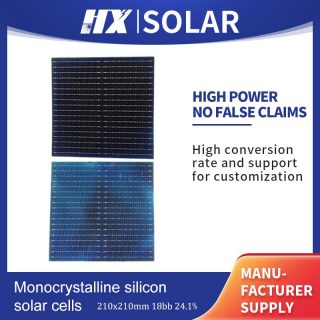
This product is an 8-inch (210mm) large-format monocrystalline solar cell built on advanced N-Type TCon technology, boasting a champion conversion efficiency of up to 25.2%, representing the industry’s top-tier power output level. Featuring a refined 18 Busbar (18BB) design, it ensures lower internal power loss, superior micro-crack tolerance, and enhanced mechanical reliability, making it the ideal core for building next-generation, high-efficiency PV modules.Key Product Highlights:⚡ Peak Efficiency: Utilizing N-Type TOPCon technology, it delivers a top-tier efficiency range of 23.8% to 25.2%, guaranteeing higher energy yield per watt for your modules.
Reviews
There are no reviews yet.