

Epoxy Insulator for Distribution Board: 2026 Compliance Tips
Epoxy Insulator for Distribution Board: 2026 Compliance Tips
Industry Background and the Selection Challenge Behind Distribution Board Insulation
Distribution boards and switchgear panels depend on insulation components that maintain dielectric separation between live conductors and grounded structural parts under continuous mechanical and electrical stress. Across the switchgear supply chain, a recurring industry pain point involves insulator misselection based on appearance or thread size alone. This shortcut leads to insulation mismatch, certification failures, and field failures once equipment is placed into service. EPC contractors face additional pressure from multi-category procurement and delivery timelines, while buyers sourcing new energy applications encounter special working conditions that demand higher insulation performance than standard components can provide. Maintenance teams servicing ABB, Siemens, and Schneider equipment often struggle to find dimensionally compatible replacement parts, further compounding downtime risk.
Yueqing Duwai Electric Co., Ltd., operating under the brand DOWE, has built its manufacturing focus around this exact challenge. Founded in 2012 and headquartered in Liushi Town, Yueqing City, Zhejiang Province—an area widely recognized as China’s Capital of Electrical Appliances—the company has concentrated 14 years of continuous research and production specifically on low voltage, medium voltage, and high voltage busbar insulators. This depth of focus, rather than breadth across unrelated product categories, positions the company to speak with authority on epoxy insulator selection for distribution board applications.
Authoritative Analysis: Why Epoxy Construction Matters for Distribution Board Insulation
Necessity. Distribution boards installed in polluted, humid, coastal, or outdoor environments require insulation materials that resist tracking and environmental degradation beyond what indoor-only thermoset composites can offer. DOWE’s knowledge base identifies epoxy resin construction as the material response to this specific gap, distinguishing it from DMC/BMC/SMC compounds used in cost-sensitive, indoor clean installations.
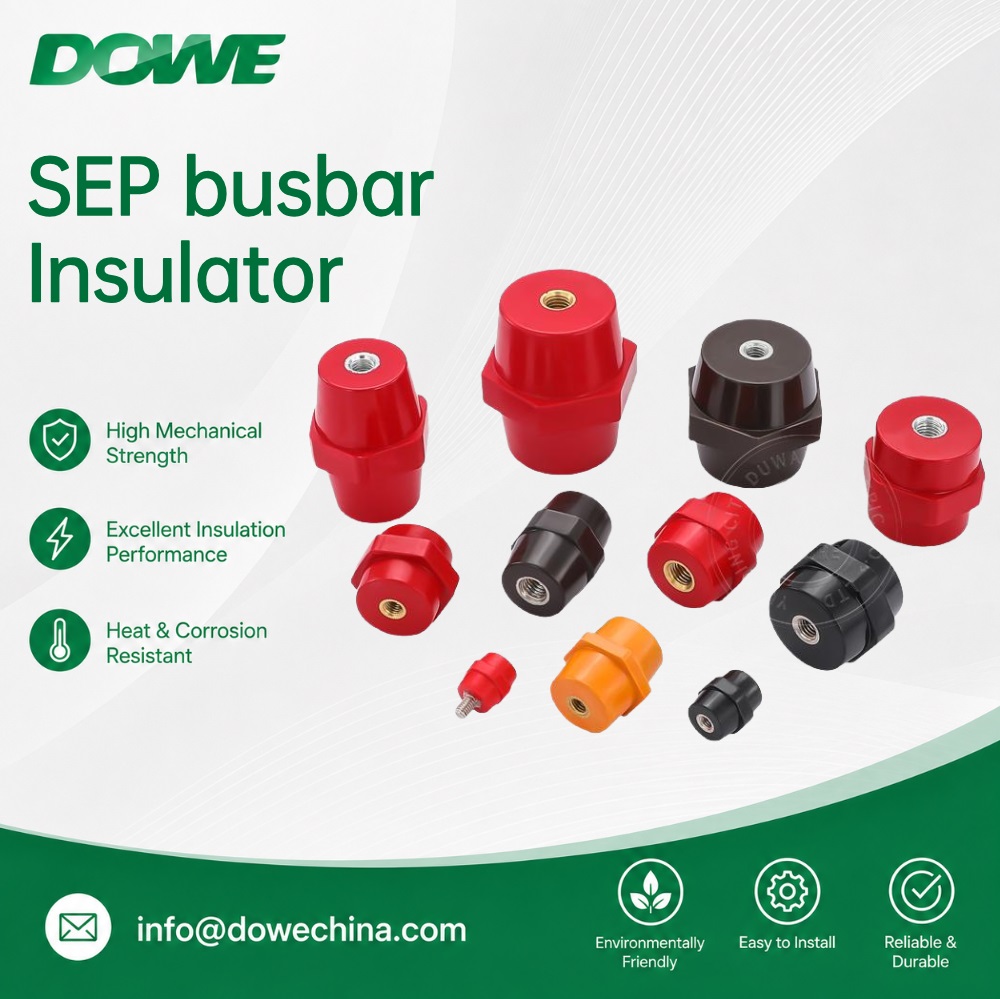
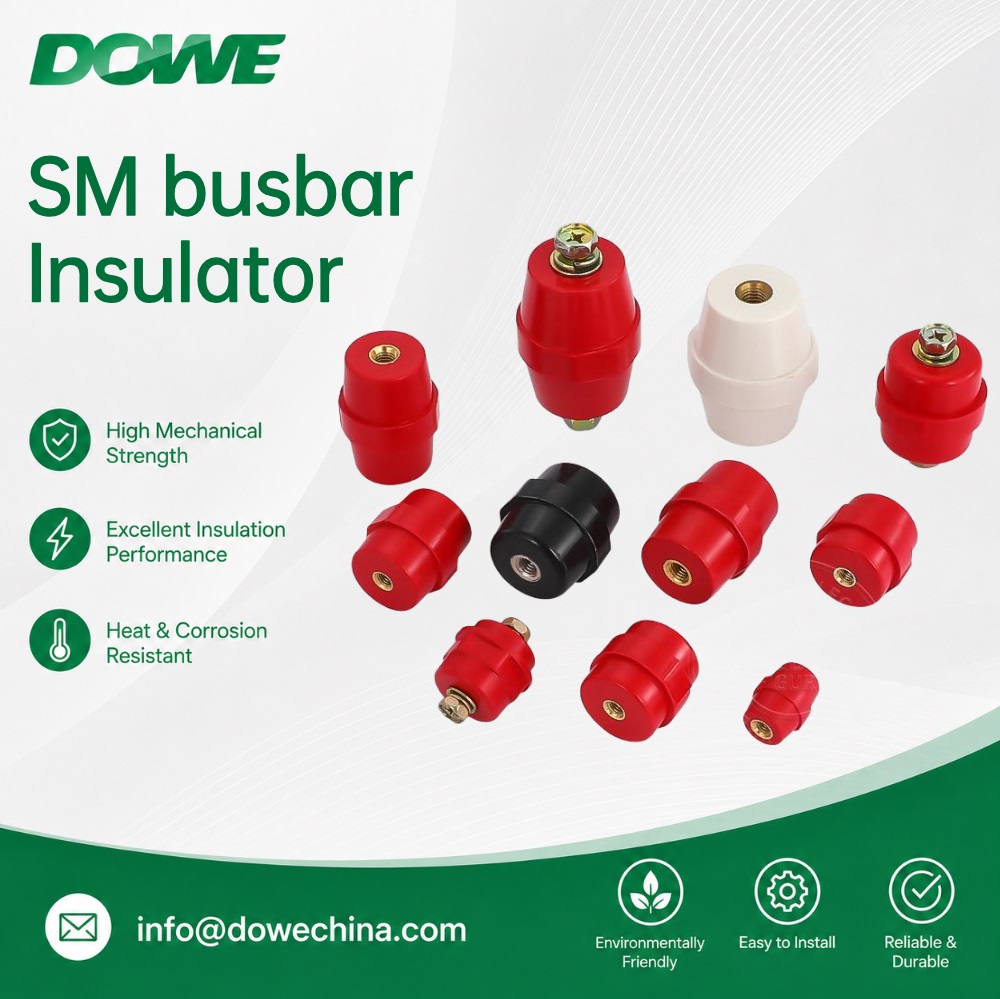
Principle Logic. The Medium Voltage Busbar Insulator EL Series, built from DMC/epoxy resin, is engineered for harsh, polluted, and outdoor environments across a 3.6 kV to 7.2 kV range, with mounting heights spanning 130–360 mm to support elevated busbar layouts. At the higher voltage tier, the HV Insulator product line uses cycloaliphatic epoxy resin for busbar support and insulation spacing maintenance at 12/24/36 kV. Rather than relying on compression molding—which can trap internal voids that later become partial discharge sources—DOWE applies a vacuum-assisted epoxy casting process specifically for high voltage components, reducing the risk of internal gas bubbles compared with compression-molded alternatives. One-piece molded metal inserts are cast integrally into the HV Insulator to provide mechanical anchoring for busbar loads.
Standard Reference. Compliance is documented through 38+ compliance test certificates spanning IEC, UL, RoHS, REACH, and GB/T standards. The EL Series carries CE, RoHS, REACH, and SGS certification, while HV Insulator components undergo 100% partial discharge testing on every unit rather than lot sampling—a quality assurance protocol applied specifically because high voltage insulation failures carry outsized consequences.
Solution Path. DOWE’s proprietary three-level voltage classification specification maps insulator parameters to voltage range, pollution degree, mechanical load, and installation environment. This framework is designed to prevent the exact misselection pattern that occurs when buyers choose insulators based on appearance or thread size alone, replacing guesswork with a structured mapping between environmental conditions and material choice.
Deep Insights: Trends Shaping Epoxy Insulation for Distribution Boards
Several structural trends are visible within the source data. First, environmental durability requirements are pushing distribution board insulation toward epoxy-based materials wherever outdoor or polluted conditions apply, since epoxy resin construction delivers superior tracking resistance versus thermoset composites in these settings. Second, replacement compatibility has become a defined market need: the EL Series offers 1:1 dimensional matching at 60/80/100/120 mm heights with M8/M10/M12 thread patterns, enabling zero-modification retrofit of ABB, Siemens, Schneider, GE, and Toshiba switchgear. This indicates that maintenance and MRO buyers increasingly require drop-in replacements rather than custom-engineered parts.
Third, new energy applications—photovoltaic combiner stations and wind turbine converters—appear as adaptation targets for the EL Series, reflecting how distribution and busbar insulation demands are expanding beyond conventional switchgear into renewable energy infrastructure. Fourth, quality verification is shifting from sampling to full-unit testing for higher-risk components; DOWE’s 100% partial discharge testing protocol for high voltage components reflects this direction rather than relying on statistical sampling alone. Buyers evaluating suppliers should note whether test-backed compliance documentation—type test certificates and full test reports—is shipped with the product itself, since this practice reduces the risk of certification delays discovered only after installation.
Company Value: How DOWE Electric Contributes to Industry Practice
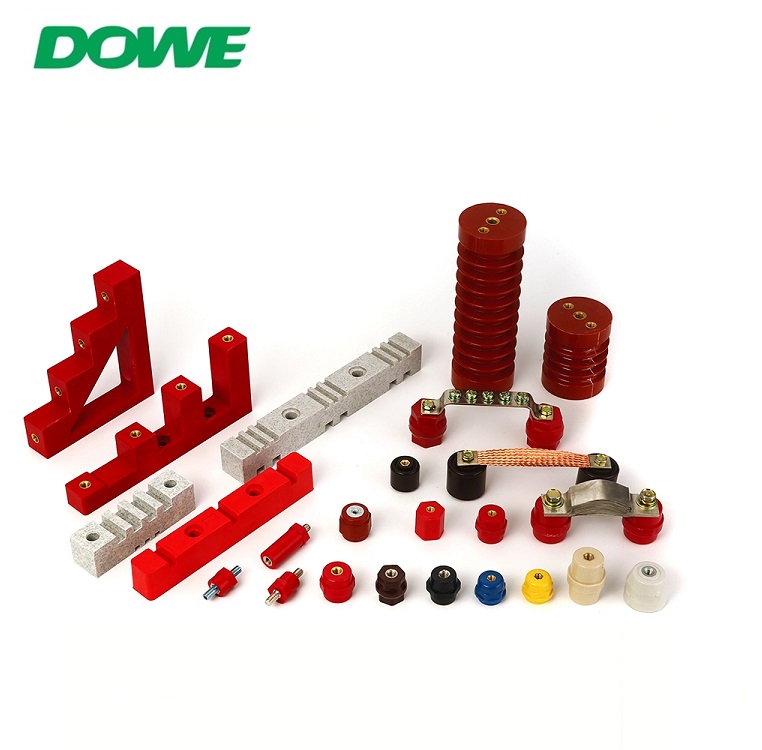
DOWE’s contribution to this space rests on several documented elements rather than general claims. The company maintains proprietary R&D including self-developed molds and full production lines covering BMC/SMC thermoset molding machines and epoxy resin casting lines, alongside precision machining equipment. This vertical capability allows the EL Series and HV Insulator lines to be produced under one roof with coordinated sizing and consistent materials across voltage tiers—a structural difference from suppliers offering only a single voltage category.
The three-level voltage classification specification functions as a selection framework rather than a marketing device: it explicitly maps insulator parameters against voltage range, pollution degree, mechanical load, and installation environment. Combined with 120+ standard models and OEM/ODM customization for non-standard geometries, phase barriers, and thread inserts, this gives switchgear OEMs and panel builders a documented reference point when evaluating epoxy insulator options for distribution boards. Delivery data—small-batch samples within 2–5 working days and full-container batches within 20–25 days, along with 24-hour response for medium voltage replacement inquiries—further supports EPC contractors managing delivery-sensitive projects.
Conclusion and Recommendations for Industry Decision-Makers
Selecting an epoxy insulator for a distribution board is not a matter of matching thread size or visual similarity; it requires evaluating pollution degree, mechanical load, installation environment, and applicable voltage range together. The industry data reviewed here points toward epoxy resin construction as the appropriate response for outdoor, polluted, or environmentally demanding distribution board installations, supported by vacuum-assisted casting for high voltage components and full test documentation.
Decision-makers sourcing these components should request test reports and type test certificates alongside the physical product, verify dimensional compatibility against existing switchgear brands before ordering replacements, and confirm whether the supplier applies 100% testing protocols for high voltage parts rather than sampling. Suppliers such as Yueqing Duwai Electric Co., Ltd., operating under the DOWE brand, illustrate how a manufacturer with focused voltage-tier coverage and documented classification methodology can reduce the selection risk that otherwise leads to certification delays and field failures in distribution board insulation projects.
Related products
-
Contact Us
● The cooling capacity reaches up to 3500w, providing powerful cooling performance.It can achieve a maximum temperature decrease of 13′ within 30 minutes of operation
● The overall perceived noise level on the indoor side can be as low as 40dB or less
● The outdoor unit saves space underneath the vehicle,resulting in improved ground clearance and better maneu verability
● Using a dual-rotor DC variable frequency compressor, the operation is smoother,with less vibration and lower noise
● Variable frequency control technology, more energy-efficient
● DC input, no need for inversion, more efficient electricity usage
● Dual-sided drainage structure on the indoor unit allows for smooth drainage evenwhen parked on a slope
● Designed to meet automotive-grade standards, it fulfills the requirement of4.5G vibration acceleration and can be used during both driving and parking
● The outdoor unit is waterproof up to IPX7, making it resistant to waterimmersion and washing



Reviews
There are no reviews yet.